崇圣寺三塔 | Three Pagodas of Chongsheng Temple

崇圣寺三塔 | Three Pagodas of Chongsheng Temple
口语化中英对照版 A Conversational Bilingual Guide
基本信息 | The Basics
在哪儿: 就在大理古城北边,走一走一公里半就到,西边靠着苍山,东边挨着洱海,位置好得没话说。 Location: About 1.5 km north of Dali's old town, tucked between Cangshan Mountain to the west and Erhai Lake to the east — you really couldn't ask for a better spot.
身份: 国务院公布的首批全国重点文物保护单位,而且是国家5A级景区(2011年晋级)。 Status: One of the very first sites China's State Council put on the national cultural relics list — and it holds the top-tier national 5A rating (upgraded in 2011)
逛多久合适: 2到3小时刚刚好,不赶时间也不会太累。 Time needed: Give yourself 2–3 hours — enough to see everything without rushing.
小贴士 | Travel Tips
想拍全景?爬上苍山往下看三塔,画面绝了。 Want the money shot? Head up Cangshan Mountain and look down — the bird's-eye view of the three pagodas is stunning.
附近有个三文笔村,专门做大理石买卖的,喜欢石头的可以顺路逛逛。 Nearby Sanwenbi Village is where locals buy and sell marble — worth a detour if that's your thing.
推荐路线 | Suggested Route
大理古城 → 崇圣寺 → 三塔 → 建极钟 → 雨铜观音殿 Dali Old Town → Chongsheng Temple → Three Pagodas → Jianji Bell → Hall of the Rain Bronze Guanyin
崇圣寺的前世今生 | The Temple's Long Story
大理这地方历史底蕴深,文物古迹一大堆,但要说最有名的,那还得数崇圣寺三塔。它几乎就是大理的代名词,也是云南的一张名片,在文物圈里名气响当当。 Dali is steeped in history, and among all its cultural treasures, none is more famous than the Three Pagodas of Chongsheng Temple. It's basically synonymous with Dali itself — one of Yunnan's calling cards, and a name that carries real weight in heritage circles.
这座寺庙称得上是华南地区最古老、规模最大的佛教建筑之一,身上贴满了云南古文化的标签。来大理不看它,等于白来。 It's one of the oldest and grandest Buddhist complexes in southern China, deeply woven into Yunnan's ancient culture. Honestly, skipping it would mean missing the whole point of a Dali trip.
崇圣寺始建于南诏国中后期,那会儿佛教正如日中天。到了大理国时期,佛教更是达到鼎盛——寺庙占地大约2.5平方公里,楼阁三座、佛塔七座、大殿九间、房间890间,里头供着11400尊佛像,规模大得吓人。更夸张的是,大理国先后有九位国王退位后跑来这儿出家当和尚,所以那会儿大理被称为"佛国"或"妙香国",崇圣寺也被誉为"佛都",一度是东南亚最大的佛寺,还是佛教文化交流的中心。
Chongsheng Temple was first built in the mid-to-late Nanzhao Kingdom, right as Buddhism was booming. By the Dali Kingdom era, it had hit its peak — the complex sprawled across roughly 2.5 square kilometers, with three pavilions, seven towers, nine main halls, 890 rooms, and a jaw-dropping 11,400 Buddha statues. Even wilder: nine Dali kings abdicated the throne and became monks here. That's how Dali earned nicknames like "the Kingdom of Buddhism" and "the Land of Fragrant Dharma," and why Chongsheng Temple was crowned the "Capital of Buddhism" — for a time, the biggest Buddhist temple in all of Southeast Asia and a real hub for Buddhist exchange.
从唐朝到明朝这上千年里,崇圣寺一直有"五大法器"傍身:三塔、建极大钟、雨铜观音像、元代"佛都"匾额,还有明代的"三圣"金像。明代大旅行家徐霞客游大理时,在《游记》里就写下过它的壮观景象——三塔像鼎足一样立着,观音铜像高达三丈(约10米),建极大钟直径一丈多、厚近一尺,钟声能传出去80里(约40公里)。
Across the roughly thousand years from the Tang to the Ming dynasties, the temple was known for its "Five Great Treasures": the Three Pagodas, the Jianji Bell, the rain bronze Guanyin statue, a Yuan-dynasty plaque reading "Capital of Buddhism," and Ming-dynasty gold statues of the "Three Saints." The famed Ming explorer Xu Xiake visited Dali and wrote about the temple's grandeur in his travel journals — the Three Pagodas standing like the legs of a tripod, the bronze Goddess of Mercy towering three zhang (about 10 meters), and the Jianji Bell so massive its diameter topped a zhang, its walls nearly a chi thick, with a sound that carried 80 li (around 40 km).
好景不长,清朝咸丰、同治年间战乱不断,寺庙被毁,1925年又遭大地震,最后只剩三座塔孤零零地立在那儿。1961年,国务院把三塔列入首批全国重点文物保护单位。1978年维修三塔的时候,意外从塔里挖出680多件珍贵文物,崇圣寺再次成为全球关注的焦点。1997年和1999年,大理白族自治州和大理市分别重铸了建极大钟、重建了雨铜观音殿,下决心要改变"有塔无寺"的尴尬局面,把崇圣寺这座国家级文物真正修复起来。在各方支持和共同努力下,这项浩大的重建工程终于在2005年4月完工。
Good things don't always last, though. During the Xianfeng and Tongzhi reigns of the Qing dynasty, the temple was ravaged by war, and a major earthquake in 1925 finished the job — leaving only the three lonely pagodas standing. In 1961, the State Council listed them among China's first batch of nationally protected relics. Then in 1978, restoration work on the pagodas turned up an unexpected treasure trove: over 680 precious artifacts hidden inside, putting Chongsheng Temple back in the global spotlight. In 1997 and 1999, local authorities recast the Jianji Bell and rebuilt the Rain Bronze Guanyin Hall, determined to fix the awkward "pagodas with no temple" situation. With support pouring in from all sides, the massive rebuilding project finally wrapped up in April 2005.
新建的崇圣寺东西长1136米,南北宽352米,规模相当可观。设计上参考了各地名寺和中国传统建筑手法,既有北方建筑的大气磅礴,又有南方建筑的精致细腻。整个寺庙沿一条主轴线和两条辅轴线布局,共8个台层、9个院落、11个层次。主轴线上依次是:金翅鸟广场(中间立着金翅鸟雕像)、山门(基座两层高4.5米)、天王殿(中间供奉摩诃迦罗,两侧是四大天王)、弥勒殿(大肚弥勒和韦陀相对而立,两侧八大天王)、十一面观音殿(9米高观音像)、大雄宝殿(三圣金身)、阿嵯耶观音阁(12米高观音像),再往上是山海大观石牌坊和望海楼。两条辅轴线上则分布着罗汉堂、高僧殿(供奉那九位出家为僧的国王)、祖师殿(供奉禅宗六位祖师)、天王殿、佛学院,以及僧人宿舍、方丈室、客房和斋堂。
The rebuilt Chongsheng Temple stretches 1,136 meters east to west and 352 meters north to south — an impressive footprint. The design drew on famous temples elsewhere and traditional Chinese architecture, blending the grand scale of northern-style buildings with the refined delicacy of southern ones. It's laid out along one main axis and two side axes, with 8 terraced levels, 9 courtyards, and 11 tiers overall. Walking the main axis, you'll pass: the Golden-Winged Roc Square (centered on a roc statue), the Temple Gate (its base rising 4.5 meters over two stories), the Hall of Heavenly Kings (Mahakala flanked by the Four Heavenly Kings), the Hall of Maitreya (the pot-bellied Maitreya facing Skanda, flanked by Eight Heavenly Kings), the Hall of the Eleven-Faced Guanyin (a 9-meter statue),
the Hall of the Great Hero (gold statues of the Three Saints), the Pavilion of the Acuoye Guanyin (a 12-meter statue), and finally the Mountain-Lake Grand View archway and the Lake-Viewing Tower. Along the two side axes, you'll find the Arhat Hall, the Hall of Eminent Monks (honoring those nine kings-turned-monks), the Hall of Founders (the six patriarchs of Zen Buddhism), another Hall of Heavenly Kings, a Buddhist institute, plus monks' quarters, the abbot's residence, guest rooms, and dining halls.
重建后的崇圣寺在国内寺庙里创下好几个"之最":轴线最长——从大理丽江路一路延伸到苍山望海楼,足足4公里,海拔2199米,把原来的三塔公园都包进去了;大雄宝殿最大——宽51.7米、高26米,是同类佛殿里国内规模最大的;贴金佛像最多——参照张胜温画卷和昆明筇竹寺五百罗汉的样式,寺里599尊佛像全是鎏金铜铸;木雕壁画最大——大雄宝殿内的张胜温画卷木雕,长117米、高18米,堪称世界之最;金刚杵最大——长6米、直径1米,是世界上最大的金刚杵;还有寺里的大鼓,直径3.1米,是中国佛寺里最大的鼓。
The reborn temple racked up quite a few "biggest in China" titles. Longest axis: it runs a full 4 km from the Dali-Lijiang road all the way up Cangshan Mountain to the Lake-Viewing Tower at 2,199 meters elevation, swallowing up the original Three Pagodas Park along the way. Largest hall of its kind: the Hall of the Great Hero measures 51.7 meters wide and 26 meters tall. Most gilded Buddha statues:
modeled on the Zhang Shengwen Scroll Painting and the 500 arhats of Kunming's Bamboo Temple, all 599 statues here are gilded bronze. Largest woodcarving mural: the Zhang Shengwen scroll carving inside the Hall of the Great Hero stretches 117 meters long and 18 meters high — reportedly the biggest of its kind anywhere. Largest vajra: 6 meters long and 1 meter across. And the temple drum, at 3.1 meters in diameter, is the largest found in any Chinese Buddhist temple.
三塔 | The Three Pagodas
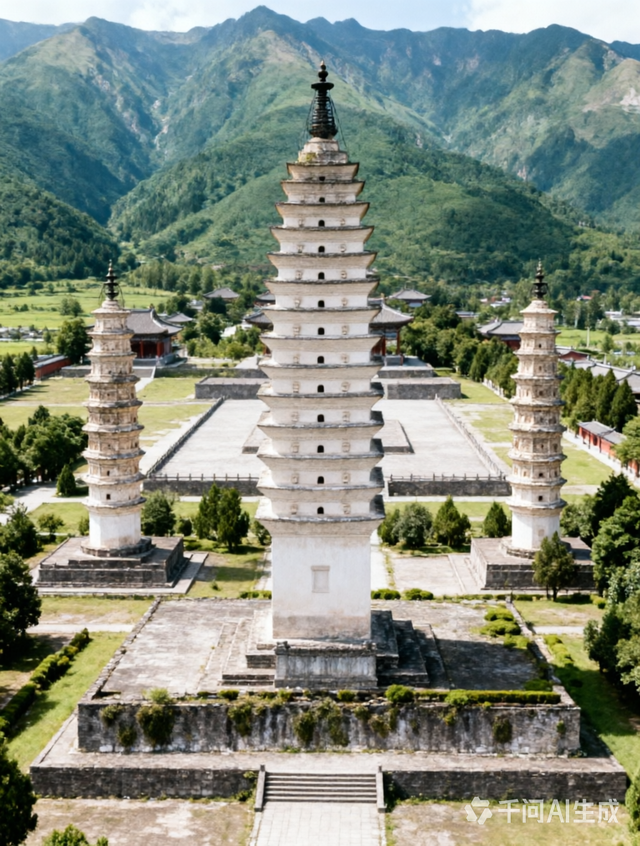
三塔——千寻塔、南塔、北塔——是崇圣寺建筑群的核心,坐落在苍山应乐峰脚下,离大理古城西边一公里。老实说,在崇圣寺重建之前,这三座塔可是这座古寺唯一留下来的东西,撑起了它几百年的名声。
The Three Pagodas — Qianxun Pagoda, plus the North and South Pagodas — sit at the heart of the temple complex, right at the foot of Yingle Peak on Cangshan Mountain, about a kilometer west of Dali's old town. Honestly, before the temple's reconstruction, these three towers were the only thing left of the ancient site — they carried its reputation for centuries on their own.
千寻塔 | Qianxun Pagoda
主塔千寻塔建于唐代,是一座空心砖塔,16层密檐式,高69.13米——在国内偶数层的塔里,它是最高的一座。塔身每一面都开着佛龛。塔前立着一面照壁,朝东,上面刻着"永镇山川"四个大字,笔力雄浑,单字就有1.7米高,出自明代黔国公沐英孙辈之手。
The main tower, Qianxun Pagoda, was built during the Tang dynasty. It's a hollow brick structure, 16 stories tall with closely set eaves, rising 69.13 meters — the tallest pagoda with an even number of stories anywhere in China. Each side has niches for Buddha statues. Out front stands a screen wall facing east, engraved with four bold characters — "Yong Zhen Shan Chuan" (roughly, "eternally guarding these mountains and rivers") — each character standing 1.7 meters tall, written by a grandson of Mu Ying, the Ming-dynasty Duke of Qian.
这四个字什么意思,说法不一。有人说塔顶有大鹏鸟镇着,能压住水里的龙,所以能防洪水;也有人说,这其实是明朝表明自己要牢牢掌控大理的决心——毕竟塔立在那儿,千百年都不会倒。
As for what those four characters actually mean, opinions differ. Some say the roc perched atop the pagoda holds a dragon in check, warding off floods. Others read it as a political statement — the Ming court declaring its grip on Dali, using the pagoda's permanence as a symbol of lasting control.
塔内有楼梯能爬到顶层,站上去俯瞰苍山洱海,视野特别开阔,值得爬。
There's a staircase inside leading all the way to the top — climb it, and you get a sweeping view of both Cangshan Mountain and Erhai Lake. Well worth the effort.
南北小塔 | The Two Smaller Pagodas
另外两座小塔,一南一北,分别离主塔70米,遥遥相对,和千寻塔一起凑成三足鼎立的格局。目前比较主流的说法是,它们建于大理国段正严、段正兴在位时期(公元1108—1172年),外观呈锥形,带着典型的宋代建筑风格——高42.19米,10层,八角形密檐砖塔(学界对具体年代还有一些争议,但这个说法引用最广)。塔身上装饰着浮雕——佛像、莲花、宝瓶,每一层图案都不太一样。塔顶覆着琉璃瓦,底座是两层八角形基座,整体看上去相当精致漂亮。
The two smaller pagodas stand about 70 meters from the main tower, facing each other from the south and north, completing the tripod formation. The most widely cited view today dates them to the reigns of Duan Zhengyan and Duan Zhengxing in the Dali Kingdom (1108–1172 CE), with a conical silhouette showing distinctly Song-dynasty stylistic influence — they stand 42.19 meters tall, 10 stories each, octagonal in shape with closely set eaves. (Scholars still debate the exact dating, but this is the mainstream account.) Their surfaces are decorated with relief carvings — Buddha figures, lotus blossoms, vases — with the pattern shifting from level to level. Each is capped with a glazed roof and rises from a two-tiered octagonal base, giving them a strikingly elegant look.
这三座塔像鼎的三条腿一样立在那儿,扛过了30多次地震,风吹雨打了上千年还屹立不倒,称得上是建筑史上的一个奇迹。作为华南地区最壮观的古塔群,三塔早就成了大理文化的象征。
Standing like the three legs of a tripod, these pagodas have weathered more than 30 earthquakes and a thousand years of wind and rain without toppling — a genuine feat of engineering. As the most spectacular pagoda cluster in southern China, they've long since become the symbol of Dali culture itself.
1978年,人们从塔里挖出689件文物,最珍贵的包括佛像、菩萨像、天王像、金刚力士像、经卷、模型小塔,还有金刚杵。其中最难得的是一尊阿嵯耶观音金像,重1135克,高28厘米,堪称稀世珍品。三塔如今是大理国家旅游度假区里最重要的景点之一。
The 1978 excavation turned up 689 artifacts in total — the most valuable among them being statues of Buddha, bodhisattvas, heavenly kings, and vajra warriors, along with scriptures, miniature pagoda models, and a vajra. The rarest find of all was a golden Acuoye Guanyin statue — just 1,135 grams and 28 centimeters tall, but an absolute treasure. Today, the Three Pagodas remain one of the standout attractions in the whole Dali National Tourist Resort.
塔到底是干嘛用的? | So What Are Pagodas Actually For?
塔这种建筑最早是从印度传过来的,早期学者把它音译成"浮屠"。最初建塔是用来存放佛教圣物和经卷的。公元一世纪左右,塔随着佛教一起传入中国,被当作佛的遗骨来供奉,后来人们又围着塔盖庙,举行佛事活动。从那以后,塔就成了佛教寺庙里少不了的宗教建筑。
Pagodas actually originated in India — early scholars transliterated the term as "futu." Originally, they were built to house Buddhist relics and scriptures. Around the first century CE, the pagoda arrived in China alongside Buddhism itself, and it came to be worshipped as a stand-in for the Buddha's remains. Temples were later built around them for religious ceremonies, and from that point on, the pagoda became an essential fixture of Buddhist temple architecture.
一般来说,塔有三个作用:弘扬佛法、镇灾辟邪、给周围景致添点美感。大理三塔这三个功能全占了,再加上极高的艺术和文化价值,难怪能成为这个地方的招牌。
Generally speaking, pagodas serve three purposes: honoring and spreading Buddhist teachings, warding off disasters and evil spirits, and simply beautifying the landscape around them. Dali's Three Pagodas check all three boxes — and with their immense artistic and cultural value on top, it's no wonder they've become the region's defining landmark.
建极钟 | The Jianji Bell
1997年,南诏国时期的建极钟被重新铸造,并且特意选在香港回归那天(7月1日)敲响。新铸的这口钟高3.86米,重达16吨。徐霞客当年在游记里是这么描述原钟的:"这钟极大,直径约一丈(约3.3米),厚将近一尺(0.33米),钟声能传出去80里(约40公里)。"这口大钟被视为崇圣寺五大法器之一。大理有个老景点叫"钟震佛国",说的就是这口钟。它的规模在云南排第一,在全国排第四。
In 1997, the Jianji Bell — originally cast during the Nanzhao Kingdom — was recast, and fittingly, it was first struck on July 1, the day Hong Kong returned to Chinese sovereignty. The new bell stands 3.86 meters tall and weighs a hefty 16 tons. Xu Xiake described the original in his travel notes: "This bell is extraordinarily large — about a zhang in diameter, nearly a chi thick, and its toll carries 80 li (around 40 km)." It's counted among the temple's Five Great Treasures, and it's the bell behind one of Dali's classic sixteen historic sights, "The Bell That Shakes the Kingdom of Buddhism." Size-wise, it ranks first in Yunnan and fourth nationwide.
雨铜观音殿 | The Hall of the Rain Bronze Guanyin
1999年,趁着澳门回归的契机,雨铜观音像被重新铸造,专门盖了一座观音殿来供奉。这尊铜像立在大殿正中央的莲花座上,底下是一个2.2米高的大理石基座。它有个特别之处——男人的身子配女人的脸,这其实反映了南诏国时期大理地区观音形象从男性向女性过渡的痕迹。整尊像高8.6米,重11吨。两旁还站着四尊其他观音的铜像(水月观音、阿嵯耶观音、男身观音、担经挑石观音),个个造型生动传神。
In 1999, timed to coincide with Macao's return, the rain bronze Guanyin statue was recast, and a dedicated hall was built to house it. The statue sits on a lotus throne at the center of the hall, atop a 2.2-meter marble base. What makes it unusual is its blend of a male body with a female face — a reflection of how Guanyin's image shifted from male to female representation in the Dali region during the Nanzhao period. The statue itself stands 8.6 meters tall and weighs 11 tons. Flanking it are four more bronze Guanyin statues (the Water-Moon Guanyin, the Acuoye Guanyin, the Male-form Guanyin, and the Guanyin Carrying Scriptures and Stones) — each one wonderfully lifelike.
观音殿二楼的墙上,还画着两幅仿制的传世名画——《南诏图传》和《张胜温画卷》,分别画在两侧墙上,把这个神秘的大理国的历史和宗教文化都呈现了出来。
On the second floor of the hall, the walls are decorated with enlarged replicas of two legendary paintings — the "Nanzhao Kingdom Picture Record" and the "Zhang Shengwen Scroll Painting" — one on each side, together telling the story of the mysterious Dali Kingdom's history and religious culture.
南诏图传: 899年由张顺、王奉宗所绘,是献给南诏末代国王的礼物。原作是彩色的,长580.2厘米、宽31.5厘米,带着浓浓的唐代风格,如今收藏在日本的一家博物馆里,这里展出的是放大版的仿制品。画面分三部分:巍山的起源、祭铁柱,还有西洱河的历史,对研究南诏国的历史、宗教和民俗都很有价值。
The Nanzhao Kingdom Picture Record: Painted in 899 CE by Zhang Shun and Wang Fengzong as a gift for the last king of Nanzhao. The original — done in color, 580.2 cm long and 31.5 cm wide, carrying strong Tang-dynasty stylistic touches — now sits in a museum in Japan; what's on display here is an enlarged copy. The scene unfolds in three parts: the origins of Weishan, the ritual worship of the Iron Pillar, and the history of Xi'er Lake — genuinely valuable material for studying Nanzhao's history, religion, and folk customs.
张胜温画卷:也叫《法界源流图》,是大理国画家张胜温1180年所作。画卷长1635.5厘米、宽30.4厘米,画了134个单体和群体人物形象,内容主要讲佛教故事,也涉及大理国的对外交往。这幅画卷充分展现了佛教在南诏、大理两国有多受欢迎,对研究大理国时期的密宗佛教也很有参考价值。
The Zhang Shengwen Scroll Painting: Also known as the "Scrolls of Buddhist Figures," painted in 1180 by Dali Kingdom artist Zhang Shengwen. The scroll runs 1,635.5 cm long and 30.4 cm wide, depicting 134 individual and group figures — mostly Buddhist narratives, but also touching on Dali's foreign relations. It's a vivid record of just how deeply Buddhism took root in both the Nanzhao and Dali kingdoms, and it's a key reference for studying Tantric Buddhism in the Dali Kingdom era.
总的来说 | The Bottom Line
新建的崇圣寺和三塔,一个庄严大气,一个精巧秀美,兼具皇家寺庙的气派和地方民族特色,把这片土地的历史文化都浓缩在了里头,也满足了现代旅游对"壮观"的期待。作为云南规模最大、全国数一数二、名扬海内外的佛教建筑群,它称得上是东南亚最有特色的佛寺建筑之一。
Put the rebuilt temple and the Three Pagodas side by side, and you get a striking contrast: one grand and imposing, the other delicate and graceful — together capturing both the splendor of an imperial temple and the flavor of local ethnic culture. It's history and heritage distilled into stone and wood, and it delivers exactly the kind of grandeur modern travelers come looking for. As the largest complex of its kind in Yunnan and one of the most renowned in all of China, it's fair to call it one of the most distinctive Buddhist temple sites in Southeast Asia.(陈大衡和他的AI)
